


Follow us on Instagram to find out more deals

Chateau Tessendey 2017
-
History of the estate
Chateau Tessendey is a family estate since 1972. Martine and Paul Bernard d'Arfeuille have updated the vineyard and the winery. Moreover the family is not unknown in the Bordeaux wine world. Since the 18th century, they have taken care the vines around Libourne and have developed a negoce activity in the 20th century. Martine d'Arfeuille was until 1998 co-owner of the Chateau Cheval Blanc (Premier Grand Cru Classé of Saint Emilion). In 2012, it is Arnaud d'Arfeuille, the son, who become the owner of the Chateau Tessendey.Age of vines
30 yearsAgeing
20% in new French oak barrels and 30% one-year barrelsBlending
15% Cabernet franc
85% MerlotTasting note
Good depth and fleshy dark plums and berries on offer with leafy notes. The palate has ample, ripe dark fruit and a juicy, plum-stone finish.Alcohol
13.5%
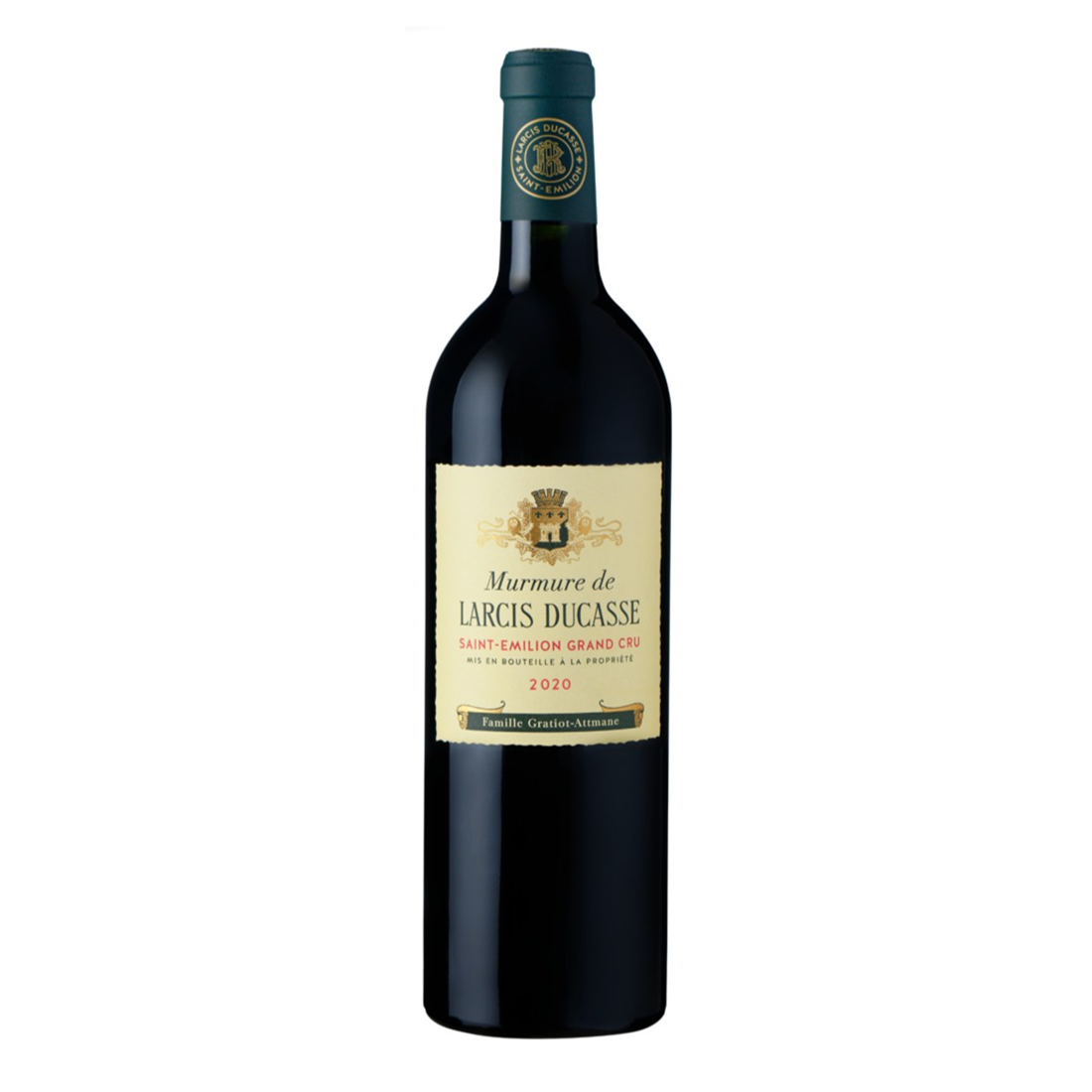
Le Murmure De Larcis Ducasse 2020
-
Appellation: Saint-Emilion Grand Cru
Owners: Gratiot-Attmane family
Manager: Nicolas ThienpontTotal area: 11,15 haArea in production: 9,80 ha
Density of plantation: 6000 vines/ha, replantations at 8888 vines/ha
Average age of the vineyard: 35 years-old
Terroirs: 10% of limestone-clay plateau on asteriated limestone, 55% of south facing terraces - very shallow loamy clay soils on asteriated limestone, 35% of limestone-clay colluvial soils on hillsides. Vineyard management: ongoing search for balances thanks to traditional light ploughing, spontaneous natural growth or inter-row planting. Continual programme of renovation of the vines: grubbing up, complantation and replanting. Numerous manual interventions: de-budding, leaf-thinning and green harvest. 100% hand-picked harvest.Harvests: Merlots from September 15th to 29th. Cabernets francs on September 29th.
Production: around 14’000 bottles
Yields: 38,8 hl/ha
Blend: 98 % Merlot, 2 % Cabernet franc
Vatting: 25-28 days
Aging: 12 months
Barrels: 225l and 500L barrels of French oak
Alcohol by volume: 14,5%
pH: 3,55
Acidity: 3,53
Lot number: L.01
Date(s) of bottling: May 3rd, 2022


Blanville - A l’Ombre des Celtis Chardonnay 2021
-
Regulated by the AOP Languedoc Pézenas appellation, Domaine des Celtis sits close to the namesake town Pézenas, also known as the habitant of Molière and where the ancient Languedoc government house was located. The Domaine was acquired and has become part of the Blanville family since 2018, adding to our range another series of beautiful terroir wines and furthering our effort in bringing out the diversity and complexity of the Languedoc terroir. “Celtis” means hackberry trees in the Latin language. These majestic and luxuriant trees are the typicality of the Pézenas region, and especially widespread in the appellation of the same name.
Terroir: Villafranchien, rolled pebbles
Appellation: IGP Pays d’Oc
Grapes: Chardonnay
Colour: White
Body: 3 / 5
Acidity: 3 / 5
Sweetness: 1 / 5
Length: 3 / 5
Lay down: 3 after vintage
Aroma/ Flavours: Floral scents, nuances of myrrh, yellow fruits, a spicy touch on the finish
Wine pairings: Fruit tart, fresh goat cheese, chicken-asparagus risotto
Vintage: 2021
Alcohol: 12.5% Vol
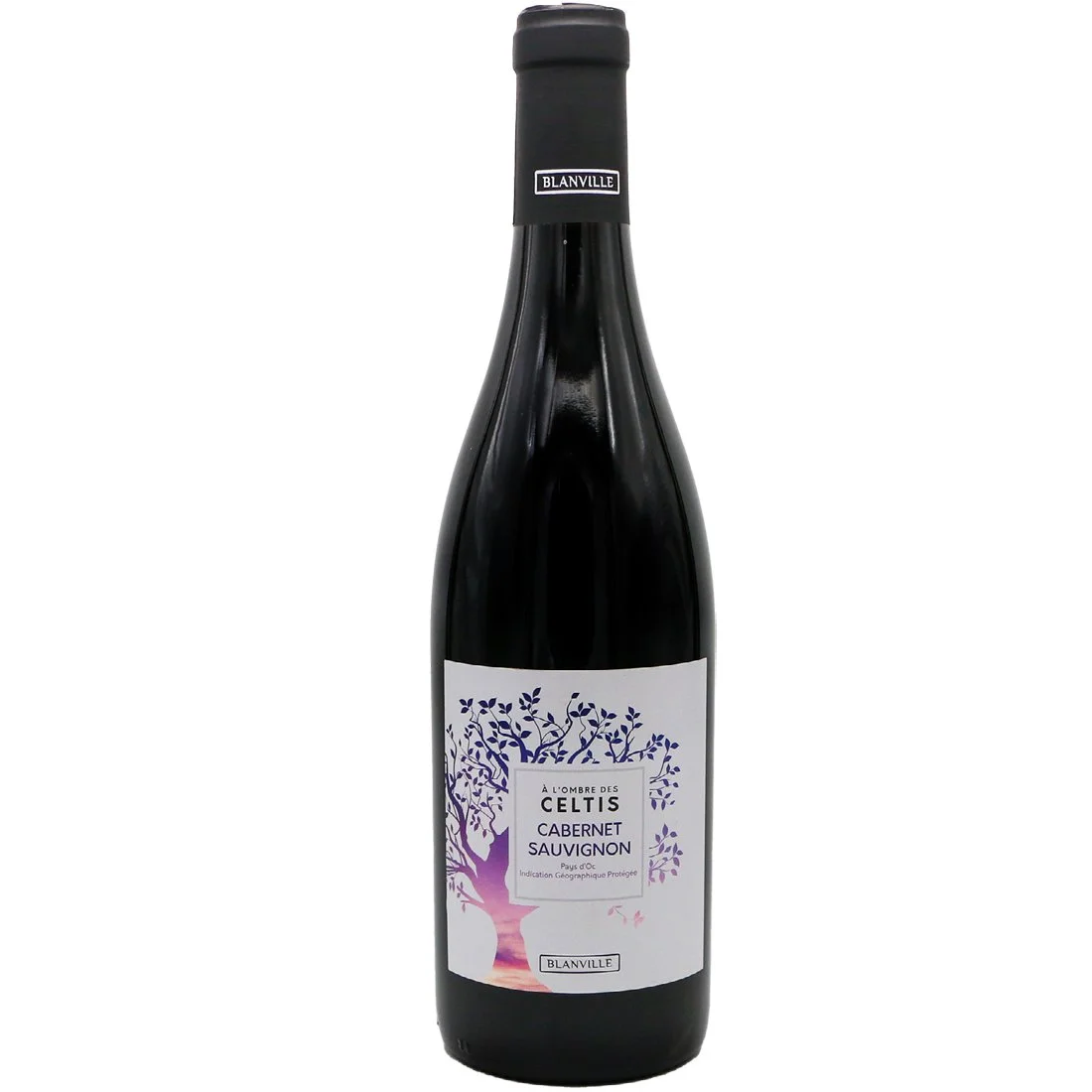
Blanville A l'Ombre des Celtis Cabernet Sauvignon 2020
-
Regulated by the AOP Languedoc Pézenas appellation, Domaine des Celtis sits close to the namesake town Pézenas, also known as the habitant of Molière and where the ancient Languedoc government house was located. The Domaine was acquired and has become part of the Blanville family since 2018, adding to our range another series of beautiful terroir wines and furthering our effort in bringing out the diversity and complexity of the Languedoc terroir. “Celtis” means hackberry trees in the Latin language. These majestic and luxuriant trees are the typicality of the Pézenas region, and especially widespread in the appellation of the same name.
Terroir: Villafranchien, rolled pebbles
Appellation: IGP Pays d’Oc
Grapes: Cabernet-Sauvignon
Colour: Red
Body: 3 / 5
Acidity: 3.5 / 5
Sweetness: 0.5 / 5
Tannins: 3.5 / 5
Length: 3 / 5
Lay down: 3 to 5 years after vintage
Aroma/ Flavours: Red fruits, liquorice, scrubland and eucalyptus
Wine pairings: Grilled beef, vegetable tian, soft cheeses
Vintage: 2020
Alcohol: 14% Vol

Blanville - A l’Ombre des Celtis Syrah, Grenache noir 2018
-
Regulated by the AOP Languedoc Pézenas appellation, Domaine des Celtis sits close to the namesake town Pézenas, also known as the habitant of Molière and where the ancient Languedoc government house was located. The Domaine was acquired and has become part of the Blanville family since 2018, adding to our range another series of beautiful terroir wines and furthering our effort in bringing out the diversity and complexity of the Languedoc terroir. “Celtis” means hackberry trees in the Latin language. These majestic and luxuriant trees are the typicality of the Pézenas region, and especially widespread in the appellation of the same name.
Terroir: Villafranchien, rolled pebbles
Appellation: IGP Pays d’Oc
Grapes: Syrah, Grenache noir
Colour: Red
Body: 3.5 / 5
Acidity: 4 / 5
Sweetness: 0.5 / 5
Tannins: 3.5 / 5
Length: 3.5 / 5
Lay down: 3 to 5 years after vintage Aroma/ Flavours: Concentrated black fruit, minerality
Wine pairings: Red meat or cheese
Vintage: 2018
Alcohol: 14.5% Vol

DOMAINES DES CELTIS Syrah, Grenache noir 2018
-
Terroir: Villafranchien -Galets roules
Appellation: AOC Languedoc
Grapes: Syrah, Grenache noir
Colour: Rouge
Body: 3.5 / 5
Acidity: 4 / 5
Sweetness: 0.5 / 5
Tannins: 3.5 / 5
Length: 3.5 / 5
Lay down: 3.5 years after vintage
Aroma/ Flavours: Black fruits burned by the sun, minerality
Wine pairings: Red meat or cheese
Vintage: 2018
Alcohol: 14.5% Vol

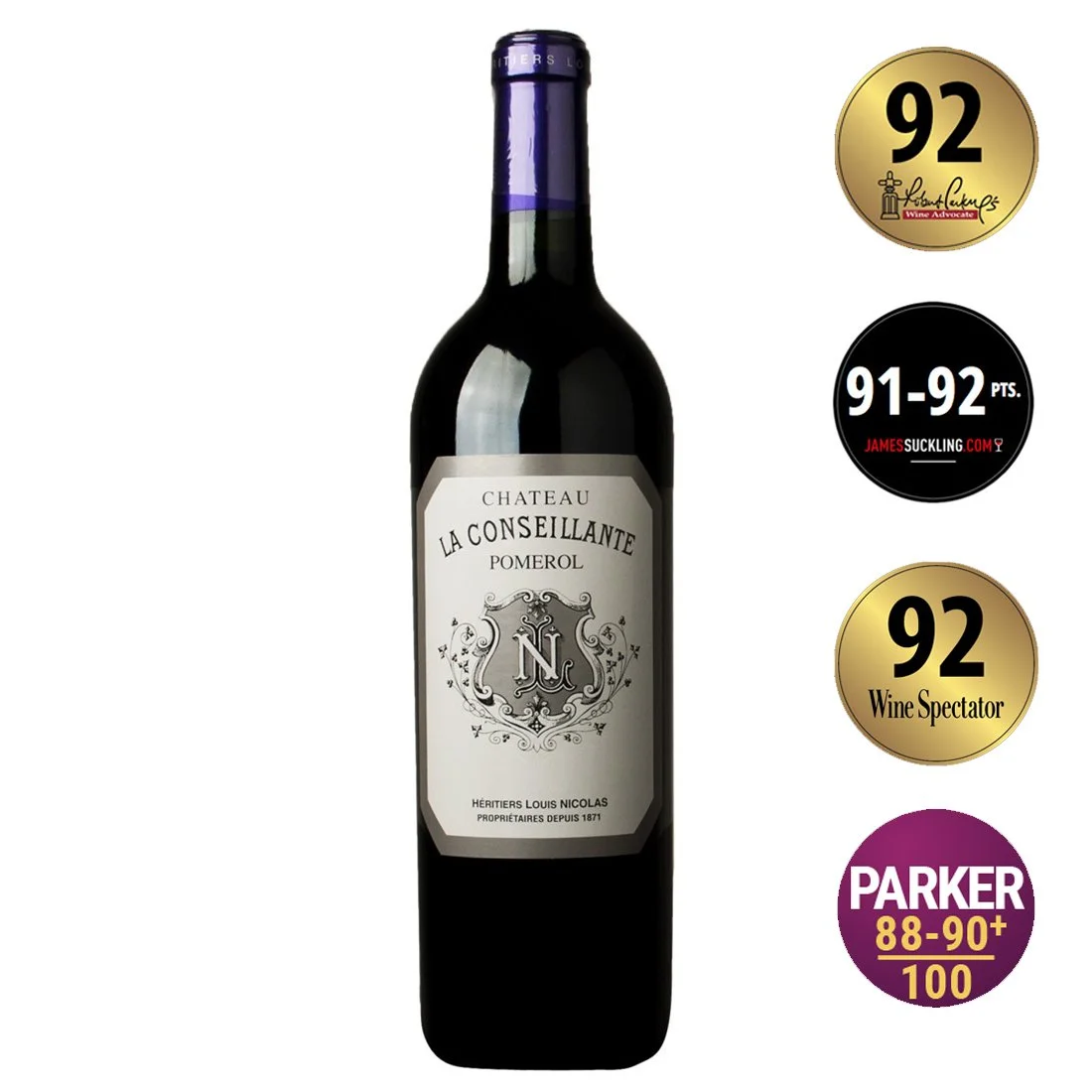
Chateau La Conseillante 2011 Pomerol
-
History of the estate
The first recorded history of La Conseillante's name appears in the mid-18th century. It was bequethed by an influential woman who owned the estate almost 300 years ago : Catherine Conseillan. The Nicolas family bought the château in 1871, and its size and configuration have not changed ever since. Exemplifying the Nicolas family's continued commitment to this great wine, the fifth generation is currently at the helm.Vinification
At La Conseillante, production is managed on a plot-by-plot basis for every stage ofthe winemaking process. Having vats of various capacities makes it possible to separately handle each plot harvested. After steeping, pre-fermentary cold-macerationis intended to preserve the freshness, aromatic qualities and colour of the vintage as much as possible.Blending
82% Merlot
18% Cabernet francVintage
2011Alcohol
13.5%Volume
750ml
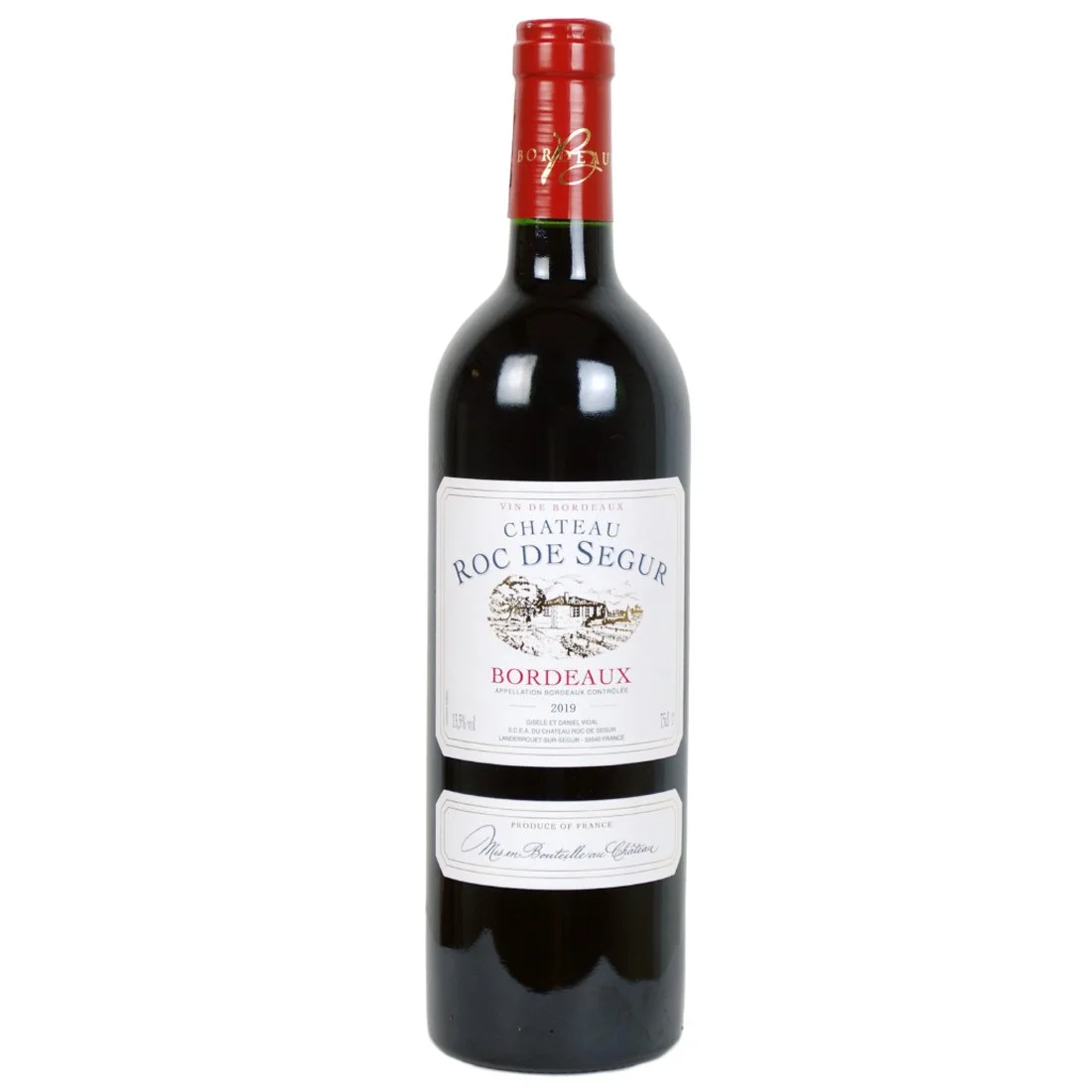
Chateau Roc de Segur Bordeaux 2021
-
History of the estate:
The Château Roc de Segur is located on Landerrouet Segur in the Entre-deux-Mers, Landerrouet is a contraction of moors and rhouets meaning, in ancient times, a wild overgrown woods and thickets; and during the late eighteenth century, these areas are cleared and developed, from the early nineteenth century, settled subsistence farming extremely rich and profuse. The vineyard of Chateau Roc de Segur has been created in 1990. Roc because the vineyard is planted on old quarries and Segur because it overlooks the river Segur.
Vinification: Traditional in stainless steel tanks with temperature control.
Age of vines: 30 years
Ageing: In tanks during 10 months.
Blending: 70% Merlot, 27% Cabernet-sauvignon, 3% Cabernet franc
Tasting note: A dark purple colour. The nose reveals red fruits aromas (raspberry, cherry). It is fresh with a beautiful structure thanks to the silky tannins, and it can be aged

Chateau la Croix Bonneau Cuvée Prestige Montagne-Saint-Émilion 2018
-
History of the estate
Château La Croix Bonneau is an old property located in Montagne. It was purchased in 2005 by the current owners, who implemented a new policy based on low yields and terroir expression. Yields are now 38hl per hectares, thanks to a short pruning, and green harvest if needed. The entire crop is carefully harvested by hand, and several sorting waves are carried out before vatting. Consulting by the Michel Rolland team. It's in 2014 that Sarah and Bruno MARCHAND, neighbours of the estate, take it over. Bruno has grown and been interested in winemaking and winegrowing since his youngest age, but also in the management of the appellation, since with not even 40 years, he can count already 8 years at the presidence of AOC Montagne St Emilion. Taking over the estate, he wishes to continue to work in the respect of terroir, to produce the best wines possible each year.Vinification
Traditional in small pyramidal stainless-steel vats under controlled temperature. The Cabernet Franc are vinified in a small wooden vat with pushing-down of the capAgeing
30% in French oak barrels during 10 months (90% in 1 year old barrels, 10% in 2 years old barrels) and 70% in tanks.Blending
100% MerlotTasting note
Very intense colour, with a beautiful deep red. The nose is very complex, with ripe fruits like blueberry, blackberry, and also notes of toast, brioche. A concentrated and very velvety mouth, with a long and fresh aromatic final.Alcohol content
13%

Chateau de Chainchon Tradition Côtes de Bordeaux Castillon 2019

Folie de Chauvin 2018 Saint-Émilion Grand Cru
-
History of the estate
The smallholding of Chauvin was previously part of the ancient grand fiefdom of Corbin. This fiefdom was divided into multiple properties at an auction in 1852, and some of these properties still bear the name Corbin today. Chauvin was then acquired by Jean Laussac-Fourcaud, son-in-law of Mr Ducasse, the President of the court of Libourne, who had just bought what was to become Château Cheval Blanc. On the death of their father Henri Ondet in 1989, Marie-France and Béatrice, worthy heirs to the determination and care of their ancestors, took over the management of Château Chauvin. For more than 20 years they put all their energy at the service of the property and increased investment. Sylvie Cazes and her children bought Château Chauvin in May 2014. They want to continue the work carried out by the Ondet family while giving Chauvin the assets needed to succeed in this new page in its history.Age of vines
30 yearsAgeing
One wine barrel ageing: 14 to 16 monthsBlending
Merlot 95%
Cabernet franc 5%Tasting note
Long and linear with blackberry and chocolate character as well as walnut undertones. Medium body and a solid core of fruit and tannins. A pretty base of everything here.Chateau Chauvin is also good when matched with Asian dishes, rich fish courses like tuna, mushrooms, and pasta.
"With a strong floral accent, the wine adds wet earth, licorice and plums to its nuances. Medium-bodied, soft and silky, with sweet, dark red berries and thyme on the palate and in the finish, there is good freshness and complexity found here." - The Wine Cellar Insider
ABV 14.0%
Volume 750ml
-
History of the estate
The Château de Chainchon belongs to the same family since 1846, André Erésué, descendant of this line of winemakers, has completely restructured the property since 1952. His son Patrick (ex-cellar master of a grand cru classé in Saint Emilion) who manages the estate since 1996 has revisited the work in the vineyard (organic fertilizers, grass growing, airing of the soils, pruning, leaf removing, smaller yields) and has brought his knowledge to the winemaking. The appellation Castillon Côtes de Bordeaux is situated 45 km east of Bordeaux in the continuation of the Saint Emilion area.Ageing
After fermentations at 25° C, the wines stay in vats in order to preserve the fruit and freshness as much as possible, then they are assembled and bottled.Blending
10% Cabernet-sauvignon
40% Cabernet franc
50% MerlotTasting note
The Château de Chainchon is a good red color, the nose is of ripe red fruit, and the taste is fleshy with a good development of the tannins and a persistent final taste of red fruit.ABV 14.5%
Volume 750ml

Chateau La Rose De Vitrac Bordeaux Rouge 2019
-
History of a Passion: In the heart of the Bordeaux vineyards, the small village of Soussac stands on the slopes of the Butte de Launay, the highest point in the region. It is here that many generations of the Jolivet family have looked after their vines. Domaine de Saint Florin once saw pigrims passing on their way to Compostella, but the current building is in the purest 19th-century regional style. In 1981, Mr and Mdm Jolivet took over the destiny of the 27-hectare family estate. Over the years, they have modernised and extended it, while remaining true to their fundamental principle: working their craft with the greatest care. This passion for their profession means taking personal control over all the different stages, from the colour change of the grapes through the winemaking process. In 1999, they joined together with neighbouring winegrowers to build a waste-water treatment plant and contribute to protecting the natural environment that is so dear to them. Today, Mr and Mme Jolivet make a Bordeaux red, a Bordeaux white and a Bordeaux rosé which are truly worthy of the terroir of Bordeaux.
Grape varieties: Merlot, Cabernet Sauvignon, Cabernet Franc
Tasting note: After its lovely crimson-ruby colour with raspberry tints, this red Bordeaux wine reveals a nice powerful bouquet of red fruit scents with hints of flowers, spices and mildish mint. On the palate, it is fleshy, rounded and fruity with fine, mature tannins and a lovely fresh finish.
Dishes: with pâté, roasted red meat, grilled white meat, lamb stew and selections of hard cheeses.
Service about 17-18°C
Vintage: 2019
Alcohol content: 13.5%

Château Cantemerle 2018 Haut Médoc Grand Cru Classé
-
History of estate
Château Cantemerle is a winery in the Haut-Médoc appellation of the Bordeaux wine region of France, in the commune of Macau. The wine produced here was the final estate to be classified as one of eighteen Cinquièmes Crus in the Bordeaux Wine Official Classification of 1855.Located on the left bank of Bordeaux in France, the magnificent Grand Cru Classé of Haut-Médoc – Château Cantemerle – testifies to a rich wine history with origins dating back to the 12th century.
Blend:
Cabernet Sauvignon 67%
Merlot 20%
Cabernet Franc 7%
Petit Verdot 6%The wine is aged for 12 months in French oak barrels (40% new wood). With its unique style that blends charm, voluptuousness and elegance.
The Château Cantemerle 2018 will seduce wine lovers by offering the pure experience of a great red wine of Haut-Médoc in an exceptional vintage for Bordeaux.
"This shows a polished yet encompassing structure of solid tannins, which support flavors of mulberries and black cherries. Medium-bodied, velvety with rather chewy. Long finish." - James Suckling
"Dry tannins and juicy fruit give this wine its structure while also bringing out the freshness of the vintage. There is a fine, juicy character that is already attractive." - Wine Enthusiast
"This is a very attractive wine that has been carefully extracted in this vintage. It has a damson fruit expression with real elegance and restrained power, followed by a dusting of cocoa powder and cinnamon (more evident on the second tasting). A little shorter than in 2016, but full of elegance and fine tannins." - Decanter
"Lively, featuring a slightly crisp hint to the red currant and pomegranate fruit, with savory and iron notes. Open-knit finish." - Wine Spectator
"The deep garnet-purple colored 2017 Cantemerle gives up lovely crushed black and red currants notes with hints of kirsch, underbrush and cinnamon stick plus a waft of roses. Medium-bodied with plenty of freshness and a fine-grained frame, it is elegantly expressed and finishes with beautiful harmony." - Wine Advocate
"The 2017 Cantemerle has quite a sultry bouquet with blackberry, damp earth and tobacco scents that reluctantly unfurl in the glass. The palate is medium-bodied with grainy tannin that frame quite voluminous black dusky fruit. There is a powdery texture to this Cantemerle, quite long on the finish even if it is missing the refinement of a top vintage." - Vinous
"Floral in nature, the fruit is ripe, crisp and even a bit sharp, but the tannins are soft and there is a lot of juicy, sweet fruit in the medium bodied, berry-filled finish." - The Wine Cellar Insider
ABV 13.5%
Volume 750ml

Chateau Grand Corbin 2018 Saint Emilion Grand Cru Classé
-
History of estate
Located on the right bank of Bordeaux, this Grand Cru Classé Saint-Émilion expands over a 28.5 hectare vineyard planted in beautiful soils of silica on blue clay.Blending
Merlot 74%
Cabernet Franc 16%
Cabernet Sauvignon 7%
Carmenere 2%
Malbec 1%Tasting note
The Château Grand Corbin 2018 is vinified in oak and concrete vats. The ageing takes place for 12 months in French oak barrels (40% of which are new wood).Chateau Grand Corbin is best paired with all types of classic meat dishes, veal, pork, beef, lamb, duck, game, roast chicken, roasted, braised, and grilled dishes. Chateau Grand Corbin is also good when matched with Asian dishes, rich fish courses like tuna, mushrooms, and pasta.
"Powerful fruits and tannins show densely in this concentrated wine. It is all about structured black fruits that are still young and vibrant with freshness among the ripe flavors." - Wine Enthusiast
"Elegant, refined, silky and fresh with beautiful purity and symmetry to the fruit. The sweetness in the red pit fruits on the nose, palate and in the finish make a great, lasting impression. The wine blends 90% Merlot with 10% Cabernet Franc. As I said in my barrel tastings, this is the finest vintage of Corbin produced yet!" - The Wine Cellar Insider
ABV 14.5%
Volume 750ml

Dame Gaffeliere 2016 Saint-Émilion Grand Cru
-
History of the estate: Situated south of Saint-Emilion with its unique silhouette, Château La Gaffelière welcomes thousands of visitors on the road D122. Formerly part of the estate, this path was offered to the community back when its people still traveled on horseback. Chateau la Gaffeliere evokes a great wine, a 1st Great Growth since the beginning of St Emilion’s classification in 1959. However growing vines on its land started during the 4th century. Our wine comes from an exceptional terroir, a “golden triangle” nested between the hills of Pavie and Ausone. But a great terroir is nothing without the willingness of men. The family de Malet Roquefort has run the estate with passion for more than 3 centuries, with a single purpose: upgrading the vineyards whilst producing an amazing ageing wine.
Vinification: Sorting of grapes by density (berry sorting) Vinification by parcel in stainless-steel temperature-controlled tanks, filled by gravity. Alcoholic fermentation with pumping over and punching down malolactic fermentation in tank
Ageing: 10 months in one-year barrel. Three rackings
Blending: 85% Merlot, 15% Cabernet franc
Tasting note: Fresh and dark berries, as well as light mocha. The palate has punchy flavors delivered in suave, fine tannins and attractive full body.
Beverage volume: 750ml
Alcohol content: 14%
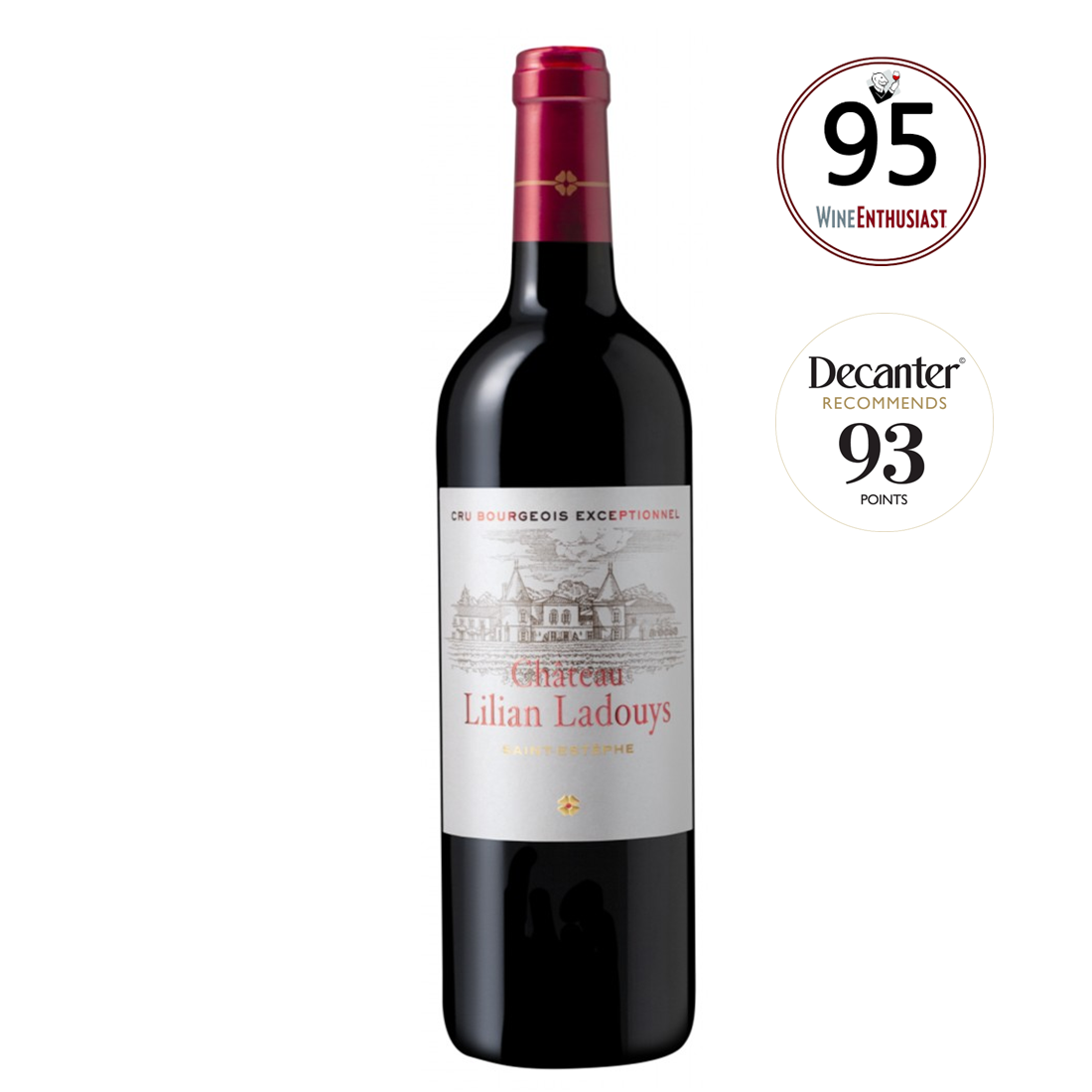

Chateau Montrose St-Estephe 2013
-
Main characteristics of the vintage Climatic conditions for the 2013 vintage were generally more difficult than in other years, highlighting the importance of the Montrose terroir and microclimate. Changeable weather meant that everyone had to be especially attentive, both in the vineyard and in the winery; it also meant taking a significant risk at harvest time. After a very cold spell in February and March, wet weather in spring held back the vegetation cycle. Flowering did not start until 6 June and took place slowly, taking until the end of the month and already heralding a slightly late vintage. Coulure and millerandage struck some of the Merlots, though the Cabernets were unaffected. It was already clear that yields would be lower than the average in previous years. July brought a hot and dry summer, very favourable conditions which prevailed until mid-September. Veraison was a little late but very even, especially in the Cabernet Sauvignon, the predominant grape variety at Montrose. Spells of rain returned in the second half of September and lasted throughout the harvest. With the weather starting to deteriorate, on 16 September our team of harvesters started preharvest leaf removal in all parcels, greatly improving ventilation of the grapes. At that point we knew that the keys to the vintage lay in the quality of our terroir and the measured risk we would be taking to enable the different grape varieties to reach optimum maturity. We started harvesting the first Merlots on 26 September, followed by the Cabernet Sauvignons from 7 October. Our terroir is remarkably well ventilated, especially the parcels of Cabernet Sauvignon on the great plateau, which helped to dry out the grapes and keep them free of botrytis. Harvesting finished late, on 16 October, but the last grapes were in good condition and fully mature. The crop was hand-sorted with particular care at the vat-house, ensuring that only the best grapes were kept. This initial selection was important, especially for the Merlots, which the weather had made more fragile. The Cabernet Sauvignons were perfectly mature and healthy and, with 70% of the blend, formed the basis of Château Montrose 2013. Overall, this is a good vintage for our wine, standing alongside classic years like 1998, when weather conditions were very similar to those in 2013.
Period of Harvest
September 26th – October 16thBlend
Cabernet Sauvignon: 68%, Merlot: 29%, Petit Verdot: 3%Tasting notes
The wine has an attractive, clear and glittering ruby colour. The nose, still slightly closed, is very fresh and minty, marked by raspberry aromas along with more toasted notes and a touch of caramel. From a clean and bright attack, the straight palate shows balance in the middle, with good grip revealing liquorice notes. The tannins are silky and elegant.

Château 'Eglise d'Armens Saint-Émilion Grand Cru 2020
-
Vineyard
Area: 25 hectares
Soil: Clay-gravel / clay-limestone
Blend
85% Merlot, 15% Cabernet Franc
Dates of harvest
Merlot: From 12 to 28 September
Cabernet Franc: From 28 to 30 September
Viticulture
Single guyot pruning. The ranks are worked every two rows to boost rooting and soil aeration. Stripping, thinning and grape sorting by density. Parcel selection
Vinification
Plot-by-plot vinification in stainless-steel vats.
• Alcoholic fermentation with pumping over and grape-treading
• Malolactic fermentation in vats
Ageing
In vats

La Reserve de Malartic Pessac 2018 Pessac-Léognan Grand Vin
-
Blending
Cabernet-Sauvignon 57%
Merlot 36%
Petit-Verdot 4%
Cabernet-Franc 3%
"Blackberry, hot-stone and blueberry aromas follow through to a full body with chewy, dusty tannins that are long and chewy. It shows lots of Pessac character, reminding me of the stoney soils of the area. Give this at least three or four years to come together. " - James Suckling
"Despite its weight, this is a well-crafted wine. It combines richness with sophisticated tannins, dense black fruits and considerable potential. Ripe berry flavors give depth. " - Wine Enthusiast
"This remains a little hidden and distant at this point in time, but there are some gorgeous rich liquorice and cassis fruits here, and the texture stands out for its silkiness. Clearly a very good wine, which opens up slowly and carefully. Classic but with depth and grip, continuing a run of successful vintages at Malartic. Last vintage before they take on Eric Boissenot as consultant. 2% Petit verdot makes up the blend, with 70% new oak for ageing." - Decanter
"Composed of 57% Cabernet Sauvignon, 36% Merlot, 4 % Petit Verdot and 3 % Cabernet Franc and aged in 70 % new oak barriques, the 2018 Malartic Lagravière has a medium to deep garnet-purple color and pronounced notions of stewed black and red plums, boysenberries and cassis on the nose, with hints of hoisin, dried Provence herbs and unsmoked cigars. The medium-bodied palate has a firm, grainy texture and just enough freshness to support the black fruit preserves flavors, finishing savory." - Wine Advocate Robert Parker
"The 2018 Malartic-Lagravière is every bit as compelling as it was en primeur. Inky dark fruit, dried herbs, licorice, lavender and chocolate are all kicked up in this sumptuous Pessac-Léognan. Soft curves and silky tannins add to the wine’s considerable appeal. 2018 is undeniably flashy and alluring, I loved it." - Vinous
"Deep in color, this beauty pops with licorice, smoke, tobacco, coffee and roasted, deep red fruits on the nose. Lush, round, fruity and creamy, with waves of sweet black, red and blue fruits that keep on coming. Give this at least 5-7 years in the cellar and enjoy it for the following 2 decades after that. The wine blends 57% Cabernet Sauvignon, 36% Merlot, 4% Petit Verdot and 3% Cabernet Franc." - The Wine Cellar Insider
ABV 14.0%
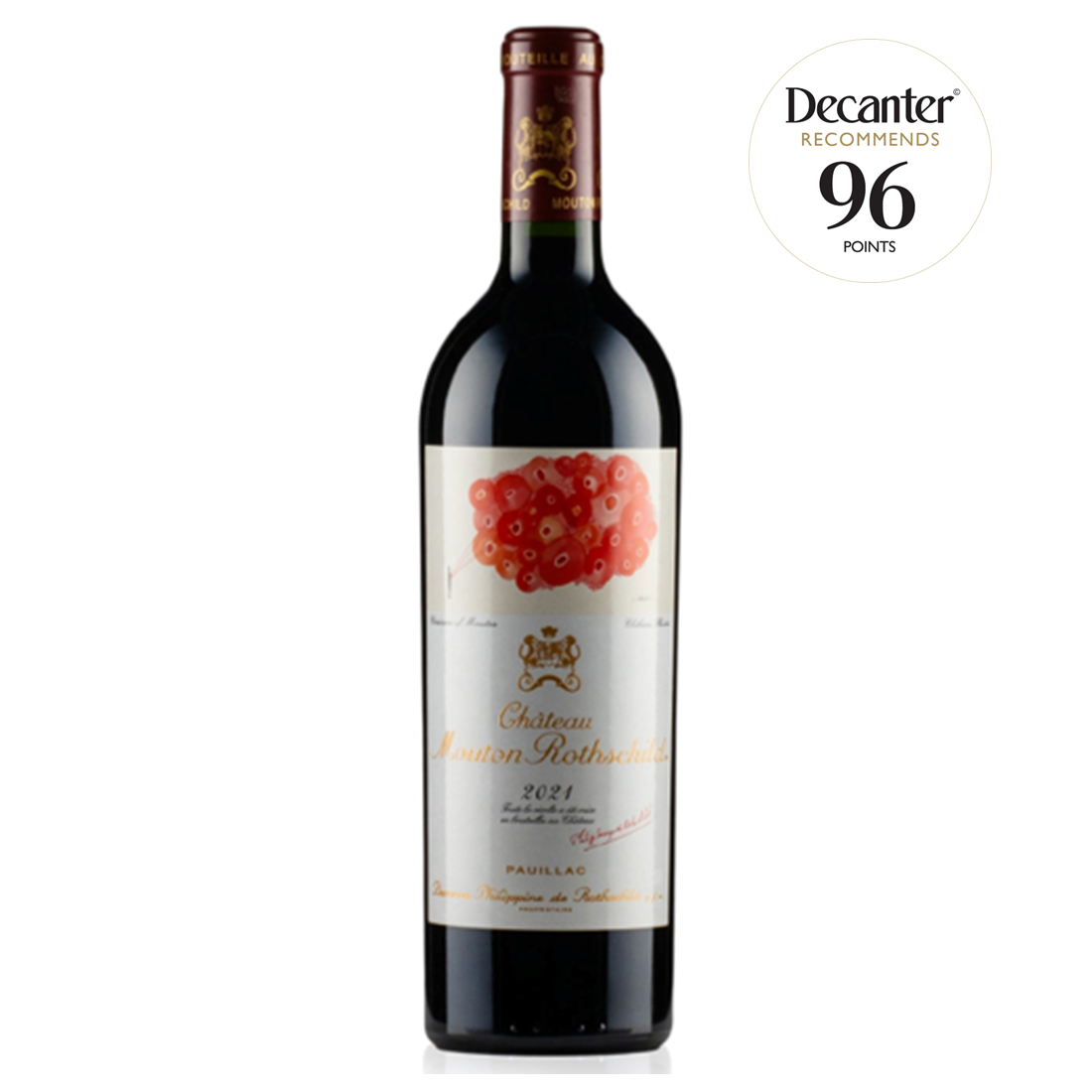
Chateau Mouton Rothschild 2021
-
CLIMATIC CONDITIONS
After a mild and wetter-than-average winter, budbreak took place early and evenly in late March. This was followed by a very dry April, including a significant cold spell, fortunately without incidence on our vineyards thanks to the influence of the nearby Gironde estuary.
May brought cool and damp weather which slowed vine growth. Flowering consequently took place within the average dates and in excellent conditions resulting from a marked rise in temperature. Unsettled and stormy conditions from mid-June to mid-July activated mildew, which remained virulent until the end of veraison. Fortunately, drought in August and early September halted the disease, while the resulting water stress improved the quality potential of the grapes grown on our gravel soils. This period was crucial for the
maturity of the pips, the development of the tannic structure and the appearance of fruit aromas and flavours.
Despite a severe threat of disease at the approach of harvest, the quality of our terroir combined with an alert, responsive and cohesive team of pickers working at a sustained pace enabled us to bring in a healthy crop at optimum maturity.
The 2021 vintage, having matured in conditions more typical of northerly latitudes, shows a return to the classic equilibrium of vintages from a generation ago, yielding fresh, well-balanced and well-structured wines that will reveal their full complexity with time.
HARVEST
From 25 September to 6 October 2021VARIETAL MIX
89% Cabernet Sauvignon
10% Merlot
1% Cabernet FrancTASTING NOTES
The wine is deep and dark, with a lustrous purple hue. The intense and elegant nose displays seductively scented blackberry and blackcurrant aromas, combined with floral notes of iris and touches of spice and cedarwood. A luscious, succulent attack leads into a beautifully balanced, fresh and harmonious palate on which bigarreau cherry flavours are enfolded in a structure of sapid, patrician tannins. Sustained by an exquisite minerality, the long, lingering finish releases a succession of spicy fresh fruit notes.ALCOHOL
13%
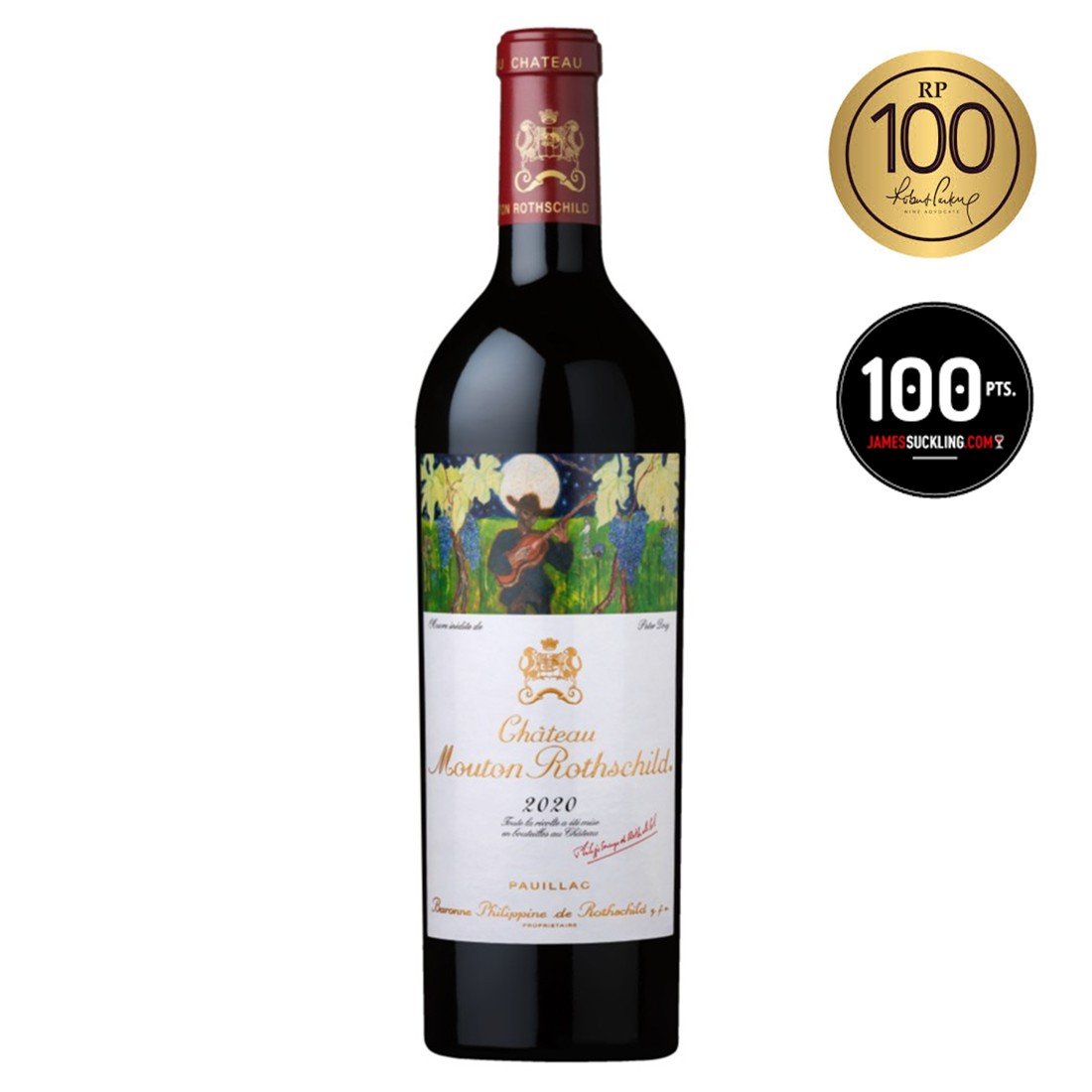
Chateau Mouton Rothschild 2020
-
Area
84 haHistory of the estate
Owned by Baroness Philippine de Rothschild, the only child of the legendary Baron Philippe, Château Mouton Rothschild has 84 hectares of vines in Pauillac. In 1853, Baron Nathaniel de Rothschild, from the English branch of the famous banking family, acquired Château Brane-Mouton, which he renamed Mouton Rothschild. In 19252, his great-grandson, Baron Philippe de Rothschild (1902-1988), decided to take over management of the estate. He oversaw winemaking there for some sixty-five years, leaving a strong mark on the estate and introducing many innovations. Since 1988, Baronne Philippine has followed in her father's footsteps not only by guaranteeing the quality of wine from this famous estate, but also by creating the Art et l'Etiquette
(Paintings for the labels) exhibition devoted to artists whose works have illustrated labels of Mouton Rothschild.Vinification
In oak vats equipped with transparent staves.Ageing
18 months in oak barrels (100% new, depending on vintage)Blending
84% Cabernet-sauvignon
13% Merlot
2% Cabernet franc
1% Petit VerdotTasting note
The wine is a deep, dark, garnet-hued cherry red. The refined and complex nose opens on remarkably ripe black fruit aromas, going on with airing to reveal blackcurrant and aniseed notes combined with touches of graphite and a subtle hint of blond tobacco. From a smooth yet full-bodied attack, the palate displays highly precise tannins which sustain an expansion of flavours in harmonious, succulent balance. Nuanced refinement is evident in touches of mint and mineral, smoky notes. The complete and exceptionally long finish expresses all the nobility of Cabernet Sauvignon at Mouton.Wine Advocate: 100
James Suckling: 100
Neal Martin: 97
Jeb Dennuck: 97Alcohol: 13%
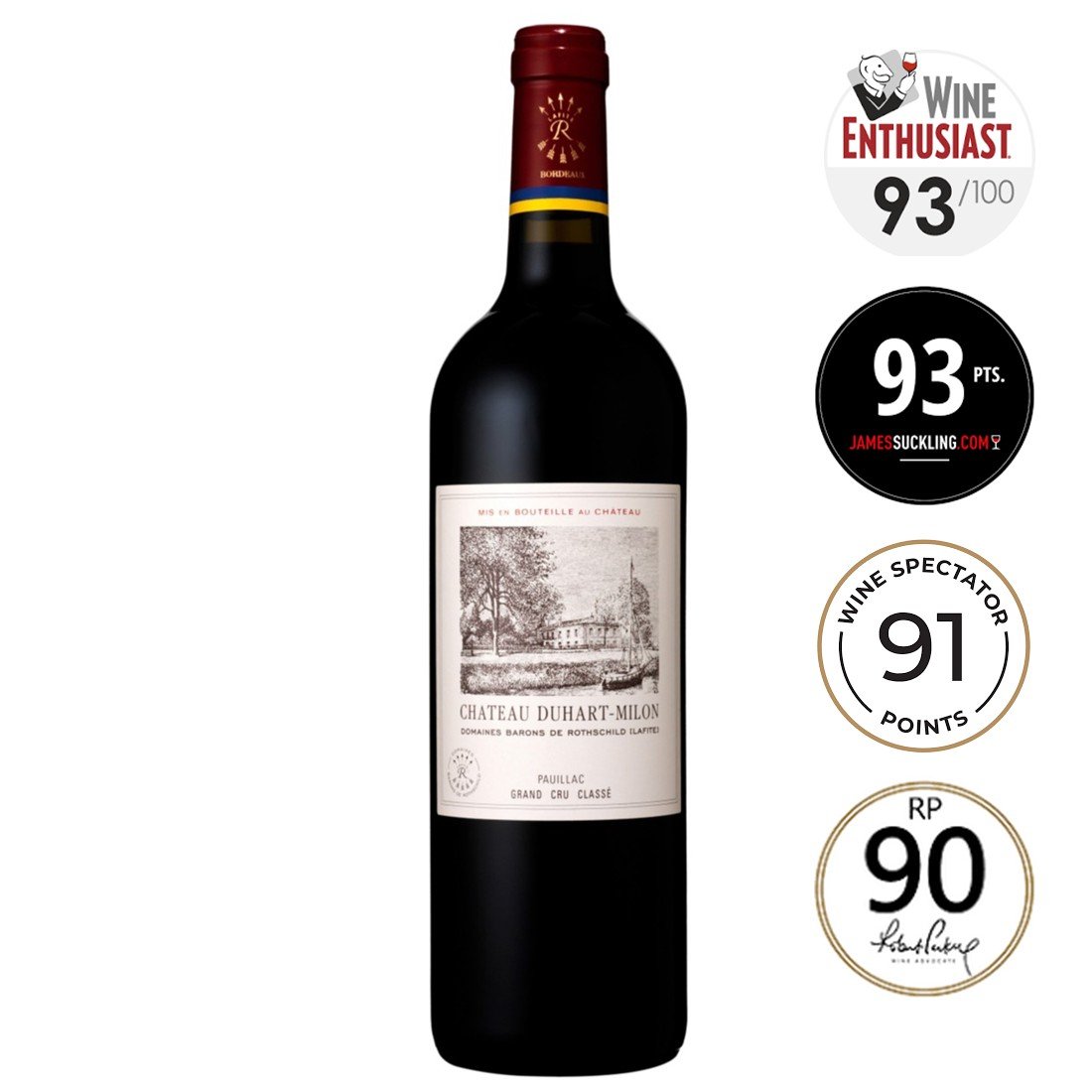
Chateau Duhart Milon 2015
-
GRAPE VARIETIES: 73% Cabernet Sauvignon, 27% Merlot
CLIMATE AND HARVEST CONDITIONS
Climate: A recurring phenomenon in recent years, the beginning of the winter was mild and dry, and it was only at the end of January that beneficial colder temperatures arrived, accompanied by rain. Bud break began in early April as usual, and the vines then grew quickly, as they had ample reserves of water and the weather was mild. In June, flowering was early and uniform, which is always a promising sign.
The influence of the Atlantic Ocean and the Gironde estuary helped to reduce the effect of a somewhat hot summer with high temperatures. Water stress was high, but rain in August brought the freshness required for the grapes to change colour and then to ripen perfectly. Conditions were ideal during the harvests, enabling us to obtain optimal ripeness for each plot.
Harvests: Merlot, 17 to 23 September; Cabernet Sauvignon, 28 September to 6 October.
VINIFICATION AND AGEING
Yield: 44 hl/ha
Vinification: Pumping over and maceration times were adjusted for each vat, depending on the origin of the plot and the tannins' degree of ripeness.
Alcoholic fermentation: in temperature-controlled concrete and stainless-steel vats.
Maceration time: 15 to 20 days
Malolactic fermentation: in concrete and stainless-steel vats.
Ageing: 14 months in barrels. 50% in new barrels and 50% in barrels that had held one wine from the Tonnellerie des Domaines.
Bottling: April 2017
Alcohol content: 12.55
Total acidity: 3.36TASTING NOTES (at bottling)
The wine has a beautiful dark garnet colour. The nose is deep, with good harmony between the young woodiness characteristic of our TDD barrels and the wine’s fresh fruit. Beautiful notes of liquorice.
On the palate, it develops quickly and is immediately very present. Consistent and balanced, it continues with tremendous length. Pleasant finish with notes of cherries. Excellent potential to improve with age.

Chateau Pailhas Vieilles Vignes 2018
-
History of the estate: It’s with a will of iron that for the last two centuries the vineyard has passed on to a whole family the desire to produce an exceptional wine. At the foot of the hills of Saint Emilion in the village of Saint Hippolyte, Pierre Lafugie was one of the first of his line of descendants during the 19th century to pass on to his descendants the passion of wine making and the love of work well done.
Vinification: Selection of plots and sorting of the harvest, traditional alcoholic fermentation in concrete tanks
Ageing: 50% in concrete tanks and 50% in French oak barrels of 1 year
Blending: 20% Cabernet franc, 80% Merlot
Tasting note: Ruby colour, very expressive aromas of black cherry, slightly toasted, finesse, freshness and very expressive fruitiness.
Alcohol content: 13.5%
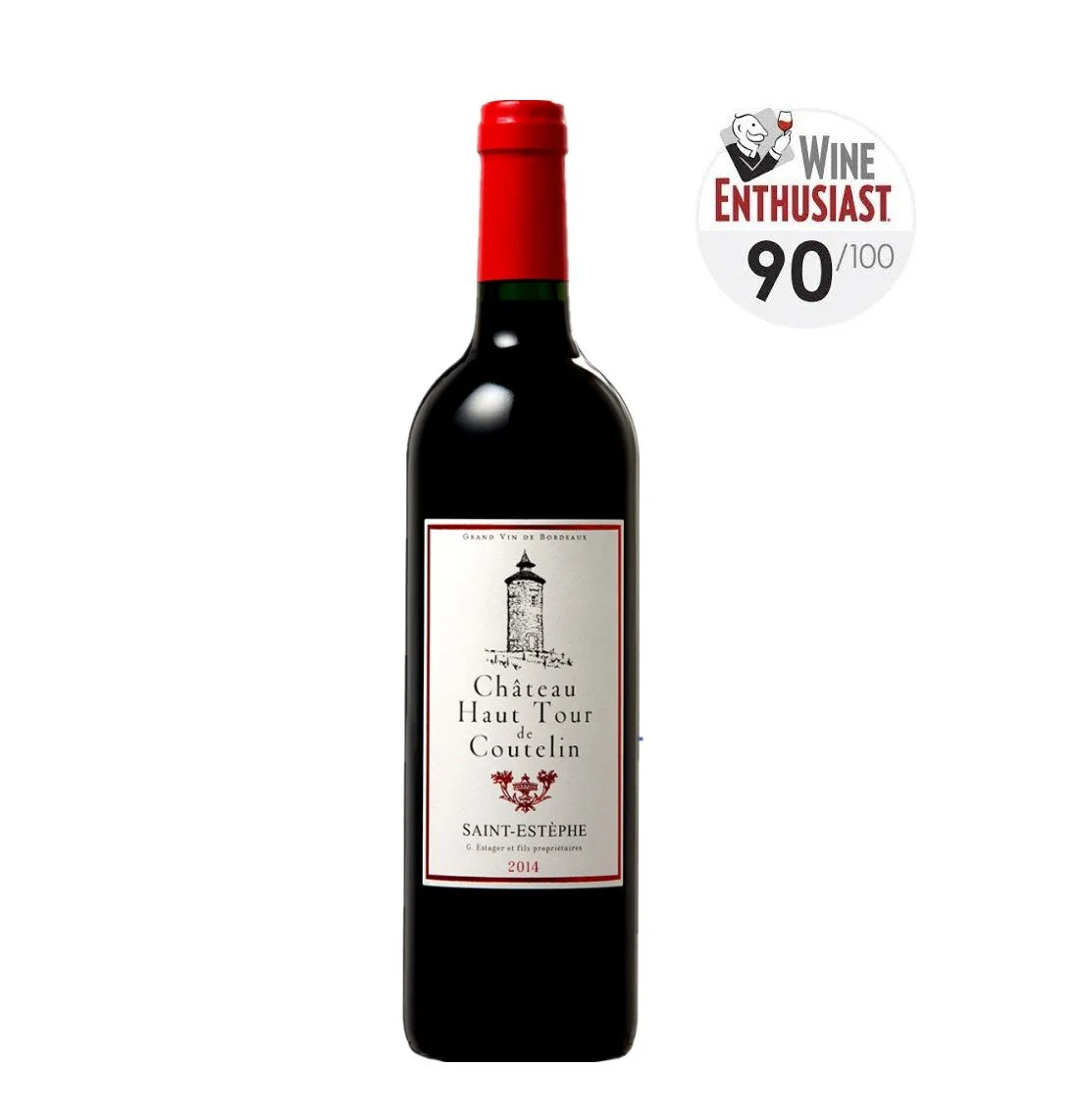
Chateau Haut Tour de Coutelin Saint-Estèphe 2014
-
History of the estate: For more than a century, this estate has been owned by the Estager family. Haut Tour de Coutelin spreads across 30 continuous hectares, in the heart of the Saint Estèphe appellation. It is situated on the Coutelin mound, which is the highest point of the Saint Estèphe village. With this exceptional terroir, a powerful, well-balanced and harmonious wine is made from 4Bordeaux grapes varieties: Merlot, Cabernet Sauvignon, Cabernet Franc and Petit Verdot.
Age of vines: 30 years
Ageing: 12 months in French oak barrels (25% new barrels)
Tasting note: Yielding a beautiful purple color, the nose is fruity with blackcurrant aromas. The palate is full with a fine density. Fruity and round wine with a nice tannic structure. Lightly oaky, the finish is elegant. A harmonious and well-balanced wine.

Chateau Petit Village Pomerol 2020
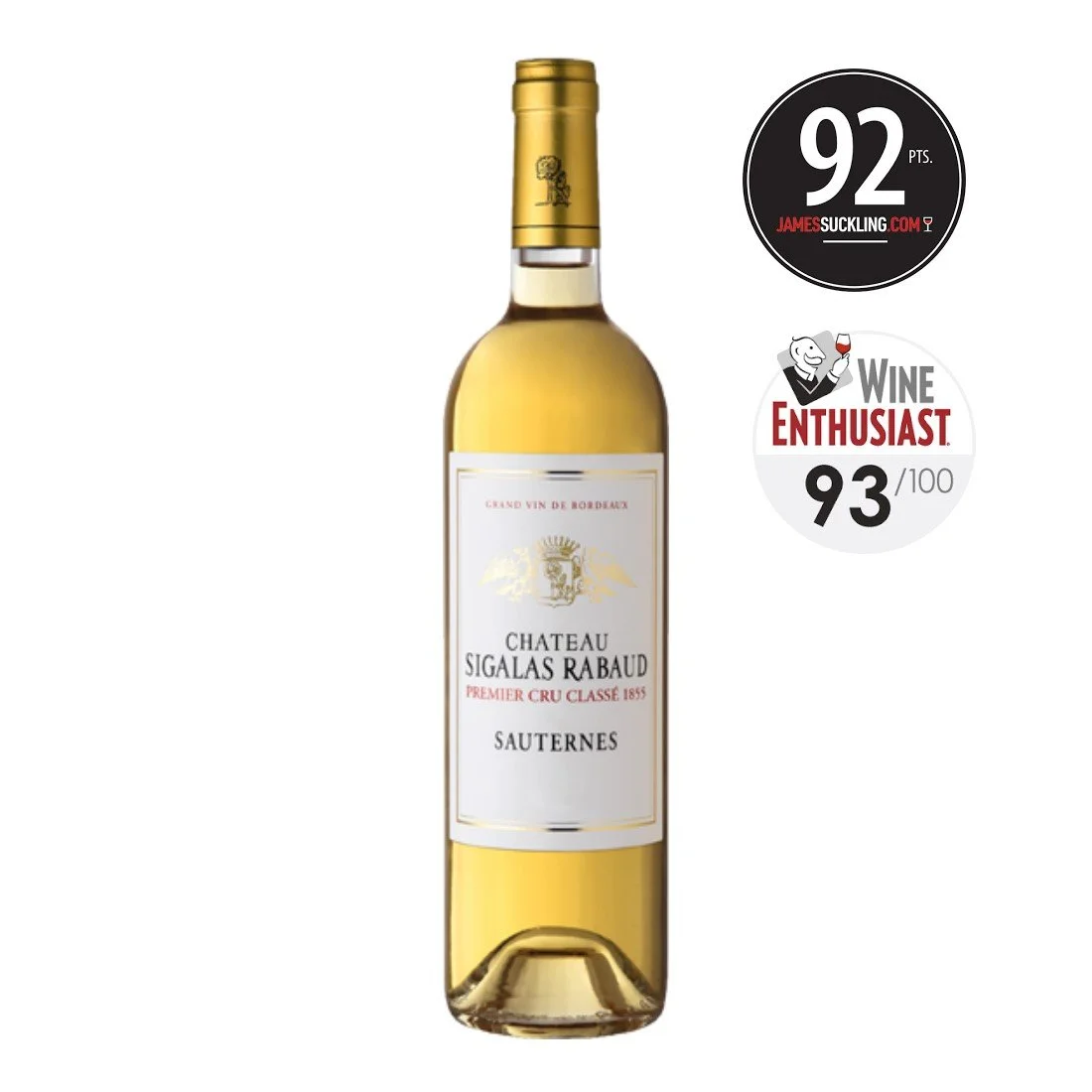
Chateau Sigalas Rabaud Sauternes Premier Cru Classé 2017
-
Description: As a family that is passionately in love with Sauternes, our objective is stay at the top and to make wines that are even better and more respectful of this unique terroir.
History of the estate: Originally from Gascony, former members of the Sigalas family have included: Counsellors in the Parliament of Bordeaux, an officer who fought for American Independence (Cincinnati) and two mayors of the town of Bazas... In 1863, Henry de SIGALAS acquired Château Rabaudet, he gave the name Sigalas Rabaud. In 1903, his only son sold half of the estate, keeping the jewel of the terroir. In 1951, his granddaughter, Marie Antoinette, the marquise de Lambert des Granges, took charge of the property. The estate is currently managed by her son, the marquis de Lambert des Granges, with the help his daughter, Laure.
Terroir: With a single plot of 14 hectares, Sigalas Rabaud is the smallest of the first growth, with an incredibly compact and homogeneous terroir. A manor house is located in the centre of the estate, surrounded by the wine making facilities and other buildings. Sigalas Rabaud is less than 500 meters from château d'Yquem. The wines are all south facing on a slight slope, on the famous Sauternes Terrace. The silica gravel soil brought by the Garonne 600.000 years ago lies on a clay base and ensures perfect nourishment for the vines. The Ciron lies to the north west: the cool waters of this small river help to provide good conditions for botrytis cinerea.
Tasting note: A magnificent pale-yellow colour with greenish tints and distils an enticing bouquet full of ripe white fruit aromas with hints of spices and cedar wood.
On the palate, it offers a crunchy texture. The juicy fruits (peaches, pears) quickly cover the palate, offering incredible richness and fullness to finish with a finish that is as persistent as it is decadent.
Alcohol content: 13.5%
Beverage volume: 750ml
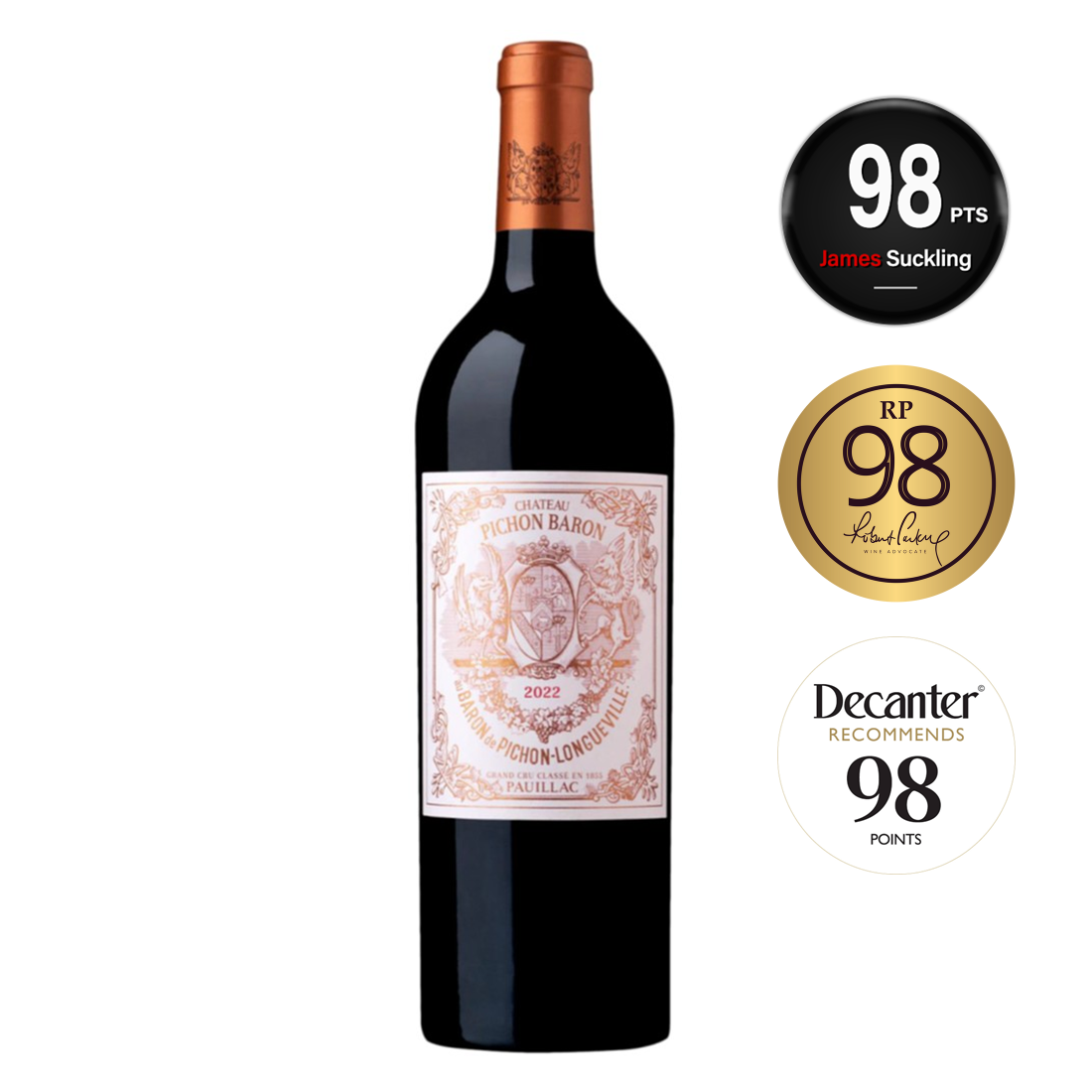
Chateau Pichon Baron Longueville 2022 (500ml)
-
Our Grand Vin Château Pichon Baron 2nd Grand Cru Classé in 1855 comes from the very oldest vines grown on the historic plots of the estate. This authentic Pauillac offers an amazing sensory experience with its black fruit flavours and spicy hints. Château Pichon Baron shows great elegance, intensity and exceptional length on the palate. It is a wine that improves year after year and can age for over 40 years in the cellar.
Vintage Conditions
A cold and dry winter, followed by a warm spring: a fairly early bud break.
At the beginning of April: a severe episode of frost, but with limited consequences.
May: flowering and fruit set took place in very good weather conditions.
June: high temperatures allowed the grapes to develop rapidly, with a first heat wave in mid-June, followed by a rainy spell beneficial for the vines.
A sunny summer, with generally high temperatures and rain-free heatwaves.
These conditions caused water constraints in our vines, however qualitative for our grapes, which gave a very promising tannic and anthocyanin richness.
Mid-August was rainy and cool, which boosted photosynthetic activity.
From 22nd August, a 4-week period of dry and very hot weather boosted ripening of seeds and polyphenols. This period without rainfall allowed the breakdown of the Cabernets’ varietal aromas. The harvest took place from 8th to 21st September for the Merlot and from 19th September to 3rd October for the Cabernet-Sauvignon.
Vinification
Our new installations are adapted for gravity loading, much appreciated among our technical teams, and for making a more precise plot selection thanks to our new wooden and stainless-steel vats, which have smaller capacities. We focused on the quality of the fruit by extending the cold pre-fermentation period before starting alcoholic fermentation with our vintage wild yeast. The fermentation process progressed quickly. Maceration temperatures were maintained between 25 and 27°C. Extractions were mainly performed during mid-fermentation, and the duration of post-fermentation maceration was refined through daily tastings. The Merlots were drawn off from 29th September to 11th October and the Cabernets from 10th to 24th October. Malolactic fermentation took place rapidly under pomace, allowing the wine to be transferred to barrels in separate batches. This was completed by 4th November.Blend
81% Cabernet-Sauvignon
19% MerlotAlcohol 14%
Ageing
70% in new barrels
30% from barrels of one vintage, for 18 months
Chateau Lilian Ladouys 2022
-
THE STORY
Owner: Family Lorenzetti
Managing Director: Emmanuel Cruse
Property Director: Vincent Bache-Gabrielsen
Vineyard Manager: Ludovic Wallet
Cellar Master: Frédéric Godart
Consulting Oenologist: Eric BoissenotTotal area: 55 ha
Production Surface: 55 ha
Density of planting: 8500 to 10000 vines /haTERROIR
Gravel clay on limestone baseIN THE VINEYARD
Every works encouraging good distribution and good aeration of grapes (pruning with windows, undoubling, stripping, suckering, grooming). Soil's work, sown or natural grass adapted in terms of the plot's vigor. Hand-picked harvest, following by a hand sorting on bunches then on berries.HARVEST START DATE
Harvest from 13th of September to the 26th of September 2021VINIFICATION
Gravitary vatting without pressing. Prefermentary cold maceration. Long vatting period. Rack and returnsAGEING
33% of new oakVARIETALS
Merlot 52%, Cabernet sauvignon 40%, Petit verdot 8%TASTING NOTES
With Merlot narrowly dominating the blend and a historically high percentage of Petit Verdot, Château Lilian Ladouys 2022 is broodingly dark in colour, revealing multi-layered aromas of dark fruits, violets and spices. It is rich and balanced in structure, not too overpowering. Round and taut on the palate, with silky, soft tannins; all the hallmarks of a very great vintage.ALCOHOL
14%
Chateau Pichon Baron Longueville 2022 (1500ml)
-
Our Grand Vin Château Pichon Baron 2nd Grand Cru Classé in 1855 comes from the very oldest vines grown on the historic plots of the estate. This authentic Pauillac offers an amazing sensory experience with its black fruit flavours and spicy hints. Château Pichon Baron shows great elegance, intensity and exceptional length on the palate. It is a wine that improves year after year and can age for over 40 years in the cellar.
Vintage Conditions
A cold and dry winter, followed by a warm spring: a fairly early bud break.
At the beginning of April: a severe episode of frost, but with limited consequences.
May: flowering and fruit set took place in very good weather conditions.
June: high temperatures allowed the grapes to develop rapidly, with a first heat wave in mid-June, followed by a rainy spell beneficial for the vines.
A sunny summer, with generally high temperatures and rain-free heatwaves.
These conditions caused water constraints in our vines, however qualitative for our grapes, which gave a very promising tannic and anthocyanin richness.
Mid-August was rainy and cool, which boosted photosynthetic activity.
From 22nd August, a 4-week period of dry and very hot weather boosted ripening of seeds and polyphenols. This period without rainfall allowed the breakdown of the Cabernets’ varietal aromas. The harvest took place from 8th to 21st September for the Merlot and from 19th September to 3rd October for the Cabernet-Sauvignon.
Vinification
Our new installations are adapted for gravity loading, much appreciated among our technical teams, and for making a more precise plot selection thanks to our new wooden and stainless-steel vats, which have smaller capacities. We focused on the quality of the fruit by extending the cold pre-fermentation period before starting alcoholic fermentation with our vintage wild yeast. The fermentation process progressed quickly. Maceration temperatures were maintained between 25 and 27°C. Extractions were mainly performed during mid-fermentation, and the duration of post-fermentation maceration was refined through daily tastings. The Merlots were drawn off from 29th September to 11th October and the Cabernets from 10th to 24th October. Malolactic fermentation took place rapidly under pomace, allowing the wine to be transferred to barrels in separate batches. This was completed by 4th November.Blend
81% Cabernet-Sauvignon
19% MerlotAlcohol 14%
Ageing
70% in new barrels
30% from barrels of one vintage, for 18 months
Chateau Duhart Milon 2019
-
At Duhart-Milon, the ideal moment to start harvesting our high-quality Merlots, planted on gravel, came on September 19th. Those on clay could wait a few more days.
This year again, we found that our Merlots on gravel (riper) were a good complement for those on clay (cooler and later), allowing us to go for good ripeness in this grape variety, which makes up a third of our blend, while retaining nice fresh fruit.
Our Cabernet Sauvignon vines seem to have better anticipated the heat this year, preventing them from shutting down in July despite the heat wave (the pressure chamber to measure stem water potential never displayed less than –1.4) and then allowing them to ripen gradually during a milder August.
Light rains in mid-September were very beneficial to the end of ripening in the Duhart-Milon gravels, more arid than those of the Lafite plateau.
Bud burst: 27 March
Mid-Flowering: 4 June
Mid-Véraison: from 8 to 12 August
Harvest: from 19 September to 4 OctoberBlend: 70% Cabernet Sauvignon, 30% Merlot
Alcohol: 13.5%
-
Blend :
60% Merlot, 32% Cabernet Franc, 8% Cabernet SauvignonYield : 27 hl/ha
pH : 3,8
Alcohol : 14,5%Soil : Deep Gravel and Clay
Size : 10,5 hectares
Average Age of Vines : 35 ans Altitude : Pomerol Plateau 38mHarvest (9-23 September)
Precise plot and intra-plot selection. Harvest separated from all co-planted and diseased vines.
Placed in cold chambers to cool down the crop to 6°C. Meticulous selection and strict sorting: manually per parcel, automatic destemmer and final sorting table by hand.
Wine making
Parcel based vinification in small, thermoregulated, concrete vats. Cold pre-fermentation maceration followed by alcoholic fermentation. Malolactic fermentation in new barrels for the best Merlot plots.
Aging: 50 % New Oak, 6 Different Coopers., mall selection aged in amphora 16 months
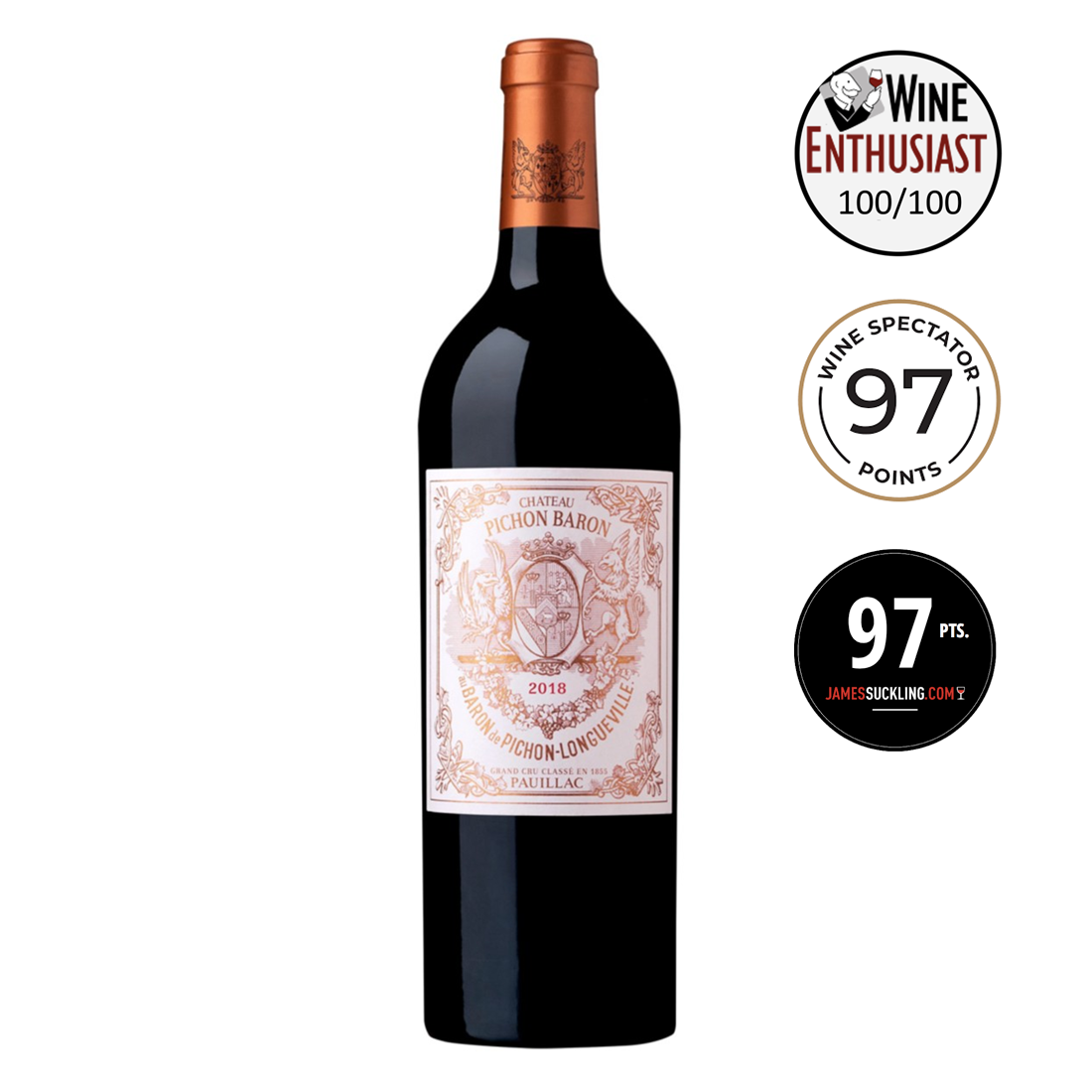
Chateau Pichon Baron Longueville 2018 (500ml)
-
Description
Château Pichon Longueville features among the top Bordeaux wines and was ranked as a Deuxième Cru in the historic 1855 classification.History of the estate
The history of the Pichon family goes back to the Middle Ages. Since then, numerous family members have played a role in the history of Bordeaux. In 1964, Jacques de Pichon, Baron of Longueville, married the daughter of Pierre de Rauzan, who created the estate. Their descendants were thereafter much involved with the Pauillac property. Raoul de Pichon-Longueville built the current Château in 1851. His family lived there until 1933. In 1987, AXA-Millésimes purchased the property from the Bouteiller family, then entirely restored the property, under the management of Jean-Michel Cazes. The château, an imposing Renaissance-style mansion with spiky corner turrets, was thoroughly restored and furnished in an appropriate mid-nineteenth century style. In 1989, an architectural competition for the construction of modern viticultural buildings was organised in collaboration with the George Pompidou Centre in Paris. Today Pichon Baron is world-acclaimed as one of Pauillac’s leading estates.Terroir
The Pichon Baron estate’s 73 hectares of very high-quality gravelly soil overlook the Latour vineyard. This exceptional land, poor in nutrients and with little excess water, nourishes the old vines sparingly so that grapes are produced in small quantities but are of supreme quality. This is a terroir that can produce the most remarkable wines; the estate has striven to do so with constancy and excellence in line with this vineyard’s early history. The Pichon Baron estate team are highly involved in their work. They devote their unswerving commitment and values of excellence and consistency to crafting wines which are ranked amongst the world’s finest. Pichon Baron’s vineyard is planted 62% to Cabernet Sauvignon, 32% to Merlot, 4% to Cabernet Franc and 2% to Petit Verdot, and has been meticulously divided into separate plots. With consummate craftsmanship each plot receives specific care and attention adapted to its particular profile (soil quality and vine age and variety).Area: 73 ha
Grape varieties:
62% Cabernet-sauvignon
32% Merlot
4% Cabernet franc
2% Petit VerdotAlcohol 14.5%
Vinification
Plot-by-plot and intra-plot selection are the foundation of our approach. This year, sorting ensured consistent vatting quality. The temperature increase was gradual in order to favour extraction. Alcoholic fermentation soon started at a moderate rate, enabling progressive extraction during the fermenting phase to suit each variety and each terroir. Temperatures were kept at 25 to 29°C.Ageing
80% in new barrels 20% from barrels of one vintage, for 18 monthsBlending
78% Cabernet-sauvignon
22% MerlotTasting note
Château Pichon Baron 2018 reveals a dark garnet colour. The precise and delicate nose offers notes of fresh fruit, black berries and spices. The attack is mellow, generous, rounded and juicy, developing powerful, well-blended tannins. The body is structured with silky, racy tannins. The flavour is carried by the structure, which preserves the midpalate. The finish is tasty, full, fleshy, and harmonious. The richness is perfectly integrated, and the style is highly characteristic, built to last through the decades, while retaining elegance and distinction.”
Chateau Pichon Baron Longueville 2018 (1500ml)
-
Description
Château Pichon Longueville features among the top Bordeaux wines and was ranked as a Deuxième Cru in the historic 1855 classification.History of the estate
The history of the Pichon family goes back to the Middle Ages. Since then, numerous family members have played a role in the history of Bordeaux. In 1964, Jacques de Pichon, Baron of Longueville, married the daughter of Pierre de Rauzan, who created the estate. Their descendants were thereafter much involved with the Pauillac property. Raoul de Pichon-Longueville built the current Château in 1851. His family lived there until 1933. In 1987, AXA-Millésimes purchased the property from the Bouteiller family, then entirely restored the property, under the management of Jean-Michel Cazes. The château, an imposing Renaissance-style mansion with spiky corner turrets, was thoroughly restored and furnished in an appropriate mid-nineteenth century style. In 1989, an architectural competition for the construction of modern viticultural buildings was organised in collaboration with the George Pompidou Centre in Paris. Today Pichon Baron is world-acclaimed as one of Pauillac’s leading estates.Terroir
The Pichon Baron estate’s 73 hectares of very high-quality gravelly soil overlook the Latour vineyard. This exceptional land, poor in nutrients and with little excess water, nourishes the old vines sparingly so that grapes are produced in small quantities but are of supreme quality. This is a terroir that can produce the most remarkable wines; the estate has striven to do so with constancy and excellence in line with this vineyard’s early history. The Pichon Baron estate team are highly involved in their work. They devote their unswerving commitment and values of excellence and consistency to crafting wines which are ranked amongst the world’s finest. Pichon Baron’s vineyard is planted 62% to Cabernet Sauvignon, 32% to Merlot, 4% to Cabernet Franc and 2% to Petit Verdot, and has been meticulously divided into separate plots. With consummate craftsmanship each plot receives specific care and attention adapted to its particular profile (soil quality and vine age and variety).Area: 73 ha
Grape varieties:
62% Cabernet-sauvignon
32% Merlot
4% Cabernet franc
2% Petit VerdotAlcohol 14.5%
Vinification
Plot-by-plot and intra-plot selection are the foundation of our approach. This year, sorting ensured consistent vatting quality. The temperature increase was gradual in order to favour extraction. Alcoholic fermentation soon started at a moderate rate, enabling progressive extraction during the fermenting phase to suit each variety and each terroir. Temperatures were kept at 25 to 29°C.Ageing
80% in new barrels 20% from barrels of one vintage, for 18 monthsBlending
78% Cabernet-sauvignon
22% MerlotTasting note
Château Pichon Baron 2018 reveals a dark garnet colour. The precise and delicate nose offers notes of fresh fruit, black berries and spices. The attack is mellow, generous, rounded and juicy, developing powerful, well-blended tannins. The body is structured with silky, racy tannins. The flavour is carried by the structure, which preserves the midpalate. The finish is tasty, full, fleshy, and harmonious. The richness is perfectly integrated, and the style is highly characteristic, built to last through the decades, while retaining elegance and distinction.”
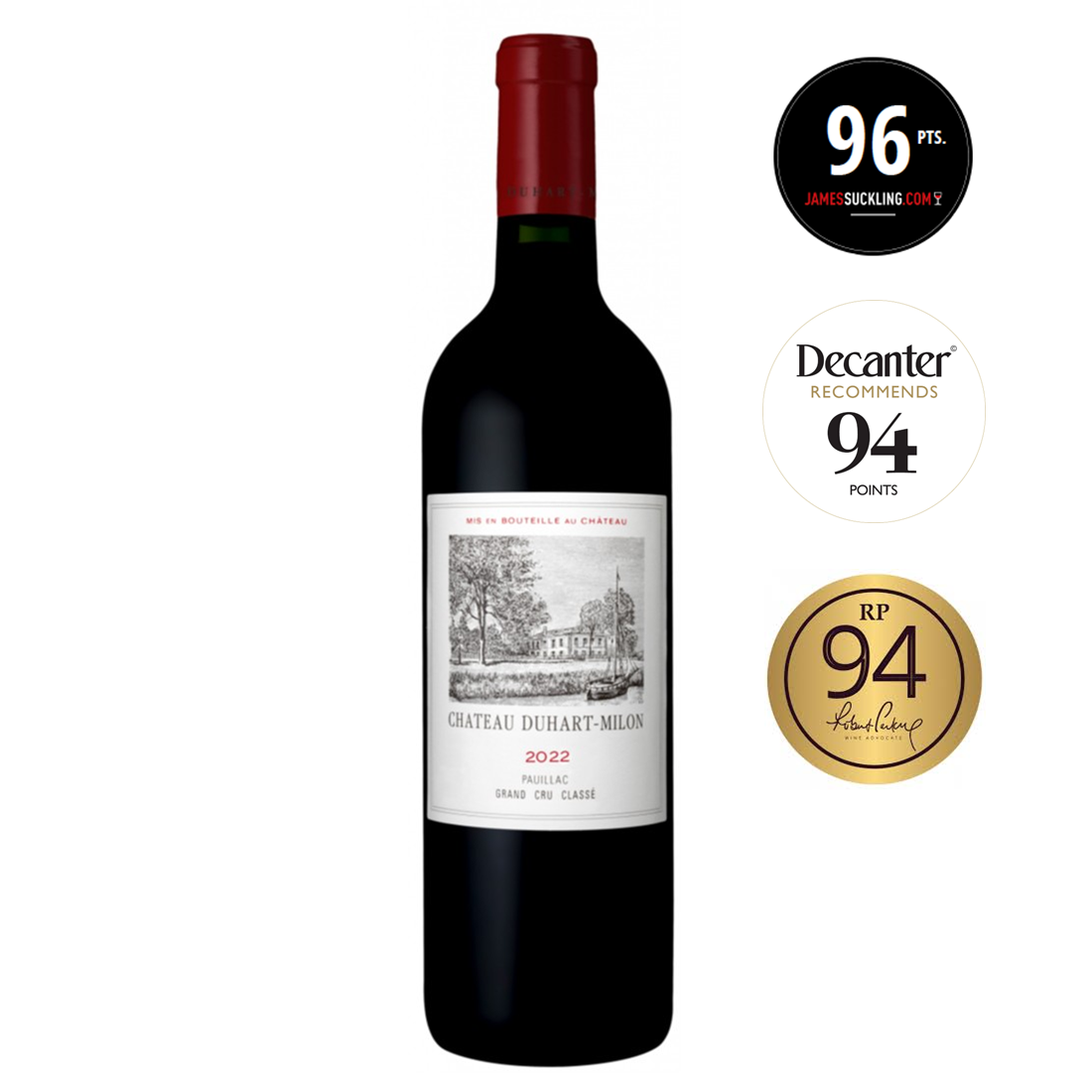
Chateau Duhart Milon 2022
-
VINEYARD ATTRIBUTES
Appellation: AOC Pauillac, Bordeaux, France
Pauillac is located on the left bank of the Gironde estuary, approximately 40km north of Bordeaux. With the tempering influence of the estuary and a great diversity of soils originating from both the Massif Central and the Pyrenees, Pauillac boasts exceptional climate and geological conditions to produce outstanding wines.
Terroir : Château Duhart-Milon’s vineyard consists of a single block of vines adjacent to Château Lafite Rothschild, on the hillside to the west of the Carruades plateau. The property has 76 hectares of vines. The soil consists of fine gravel mixed with aeolian sand on a tertiary limestone.
VINTAGE SUMMARY
The vintage began with a few frost episodes in April, but damage was limited thanks to the late start of the Merlot and Cabernet. April, marked by good rainfall, allowed for healthy vegetative growth. Flowering started at the end of May with rapid vine growth, while June brought heavy rains, creating significant downy mildew pressure, which was well managed. A long period of drought, combined with the heatwaves in July, subjected the old vines to severe water stress by mid-August. The harvest, completed on September 27th, revealed an unusual profile for Duhart-Milon, with Cabernet displaying surprising depth and richness.
WINE MAKING SCHEME
Château Duhart-Milon is made according to traditional Bordeaux methods. The grapes are carefully sorted and placed in concrete or stainless-steel vats depending on their provenance for alcoholic fermentation.Gentle pumping over is carried out during fermentation to optimize extraction. Total maceration time is about 20 days before racking. Following this rigorous selection, the wine is blended and transferred to oak barrels (50% new). Once the wines have undergone malolactic fermentation, they are transferred to French oak barrels made by the Tonnellerie des Domaines in Pauillac. Each barrel is tasted individually in December to determine which ones will be selected for the grand vin.
TASTING NOTES
The nose, somewhat discrete at this stage, is marked by great depth, hinting at the harmony of a bouquet of dark fruit. It is complemented by delicate spicy notes brought by well-integrated oak. The attack is fresh, delicate, and supple. The wine gradually takes its place and reveals a breadth that fills the palate on the finish. It is both very Duhart and very atypical, like many 2022s.TECHNICAL INFORMATION
Varietals: Cabernet sauvignon 78%, Merlot 22%
Alcohol content: 13,5 % vol.
pH: 3,82
Total acidity: 3,35 g/l

Folie de Chauvin Sainte-Emilion Grand Cru 2019
-
History of the estate: The small holding of Chauvin was previously part of the ancient grand fiefdom of Corbin. This fiefdom was divided into multiple properties at an auction in 1852, and some of these properties still bear the name Corbin today. Chauvin was then acquired by Jean Laussac-Fourcaud, son-in-law of Mr Ducasse, the President of the court of Libourne, who had just bought what was to become Château Cheval Blanc. On the death of their father Henri Ondet in 1989, Marie-France and Béatrice, worthy heirs to the determination and care of their ancestors, took over the management of Château Chauvin. For more than 20 years they put all their energy at the service of the property and increased investment. Sylvie Cazes and her children bought Château Chauvin in May 2014. They want to continue the work carried out by the Ondet family while giving Chauvin the assets needed to succeed in this new page in its history.
Vinification: Cold skin contact for 2 to 5 days at around 8°C before fermentation Alcoholic fermentation in temperature controlled stainless-steel tanks Malolactic fermentation in barrel Skin contact for 20 to 30 days - slow and gentle extraction.
Blending: 5% Cabernet franc, 95% Merlot
Tasting note: Long and linear with blackberry and chocolate character
Food pairing: Beef, lamb, deer, venison, poultry
Alcohol content: 13.5%

Château Tayac Margaux 2020
-
Area: 35 ha
Average yield of the vines: 55 hl/ha
History of the estate: Clinging to the gravelly hills of Soussans, in the heart of the prestigious Margaux appellation, the vineyards extend over 37 hectares fully offered to the sun. Family business above all, the property has been enriched by the knowledge and experience of four generations who have succeeded one another here and have made it possible to enhance both the place and the production admirably. To provide you the most prestigious wines, Guy Portet, technical director, applies the Cousinié method allowing a generous nutritional contribution to the vines while significantly limiting treatments.
Vinification: Cold pre-fermentation in stainless steel and cement tanks. Vatting for 26 to 32 days.
Fermentation in thermo regulated vats at 28°C for 6 to 7 days.
Ageing: 12 months in franch oak barrels (40% of new barrels)
Blending: 50% Cabernet-sauvignon, 42% Merlot, 8% Petit verdot
Tasting note: Purple color. Intense and complex bouquet revealing notes of liquorice, currant and blueberries. A touch of white pepper. The appetizer is slightly sweet and refreshing. The body is juicy, fruity and has well integrated tannins. The structure gives them a hard time because it is lively and racy. The whole is harmonious and endowed with a beautiful aromatic intensity.
Alcohol content: 13.5%